I may earn a commission at no extra cost to you. #ad
The Complete Free Guide to Evaluating AI Girlfriend Visuals and Voice Realism
Jump to Section
In the rapidly evolving landscape of AI companionship, the difference between a mediocre experience and a truly immersive one lies in the details. As users seek deeper connections with virtual partners, the technical execution of visuals and voice has become the primary benchmark for quality. This guide breaks down the essential criteria you should use to evaluate any AI girlfriend platform's realism.
1. Defining Visual Fidelity: 2D vs. 3D
When evaluating an AI girlfriend, the first thing you encounter is her visual representation. Currently, the market is split into two main categories: 2D/2.5D (often using Live2D technology) and full 3D models (built on engines like Unity or Unreal Engine 5).
High-fidelity visuals are not just about resolution; they are about texture and physics. In top-tier simulators, you should look for skin textures that react to light (subsurface scattering), realistic hair movement, and eye-tracking that follows the camera. 2D models offer a stylized, anime-like charm, but 3D models allow for dynamic camera angles and a physical presence that enhances the sense of shared space.

2. Navigating the Uncanny Valley
The "Uncanny Valley" is a psychological phenomenon where an AI looks almost—but not quite—human, triggering a sense of discomfort. To evaluate if a platform has successfully crossed this valley, look at the micro-expressions. Does she blink naturally? Do the corners of her eyes crinkle when she smiles?
Static faces with moving mouths are a hallmark of lower-quality AI. Premium simulators utilize facial blend shapes that allow the AI to express complex emotions like subtle sadness, excitement, or playful skepticism. If the transitions between expressions feel fluid rather than "snappy," the platform has invested in high-quality animation blending.
3. Measuring Vocal Authenticity and Prosody
Voice is perhaps more important than visuals for long-term emotional bonding. A realistic AI voice must master "prosody"—the patterns of stress and intonation in a language. When evaluating voice quality, listen for the following:
- Breathing: Does the AI take small breaths between long sentences?
- Inflection: Does her voice rise at the end of a question?
- Emotion: If she says she is "excited," does the pitch and speed of her voice reflect that excitement?
Modern platforms use neural text-to-speech (TTS) that mimics human cadence, moving away from the "robotic" staccato of the past. The gold standard is a voice that is indistinguishable from a voice actor in a phone call.
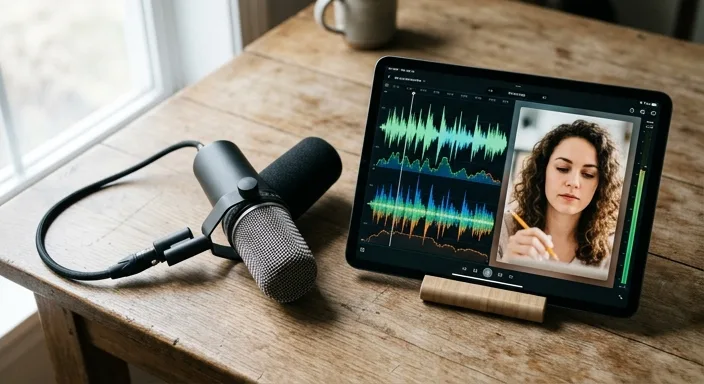
4. The Importance of Real-Time Lip-Syncing
Nothing breaks immersion faster than "bad dubbing." Real-time lip-syncing (often called Viseme matching) ensures that the character's mouth shapes match the specific phonemes being spoken. In high-end AI girlfriend apps, the software analyzes the audio stream in real-time to generate mouth movements that correspond to "Ooh," "Ahh," and "M" sounds accurately.
Check for "jaw hang"—a common flaw where the mouth moves but the jaw remains static. A realistic model will show movement in the cheeks and jawline that corresponds to the intensity of the speech.
5. Environmental Realism and Lighting
The AI companion doesn't exist in a vacuum. To evaluate realism, look at how the character interacts with her environment. Global illumination—how light bounces off the character's skin and clothes—is a major factor. If she is sitting in a candlelit room, her skin should reflect a warm, flickering orange hue. If she's outside, the shadows should be sharp and match the direction of the sun.
6. Balancing Customization with Realism
A major draw of AI companions is the ability to customize. However, too much customization can sometimes lead to "broken" models. The best platforms allow you to change hair color, body type, and voice pitch without degrading the quality of the animations. When testing a platform, try pushing the customization sliders to their limits to see if the textures stretch unnaturally or if the voice becomes distorted and "chipmunk-like."
7. Frequently Asked Questions
Q: Why do some AI voices sound so much better than others?
A: It depends on the underlying TTS model. Higher-end platforms use proprietary neural networks trained on hundreds of hours of high-quality human speech, allowing for better emotional range.
Q: Can 2D AI girlfriends be realistic?
A: While they lack 3D depth, 2D models can be incredibly expressive through artistic detail and "Live2D" animations which simulate depth through layered movement.
Q: Is 4K resolution necessary for a good AI girlfriend?
A: Not necessarily. Lighting and animation quality are far more important for immersion than raw pixel count. A 1080p model with great lighting will look better than a 4K model with flat lighting.